Most businesses approach content the same way. Write a few blog posts. Keep the homepage updated. Add a news section that gets three articles and then quietly goes dormant. Repeat the strategy that isn't working, slightly harder.
The data from one of my client's websites tells a different story, and it's instructive for any London clinic trying to build organic search traffic that actually converts.
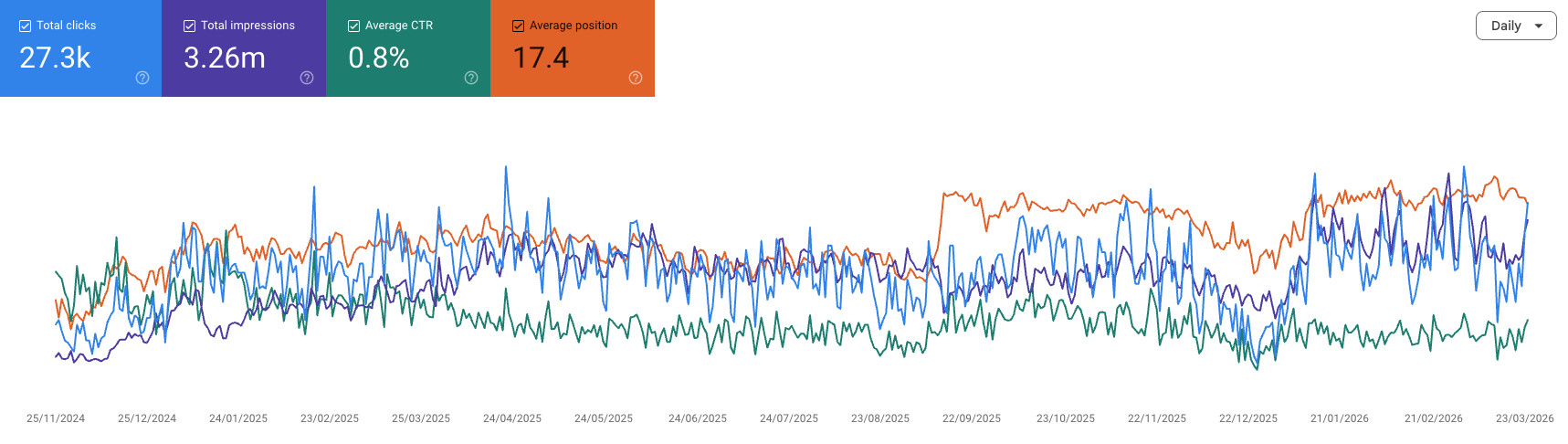
Over a sixteen-month period, antiwrinkleclinic.co.uk generated 3.26 million impressions and 27,300 clicks through Google Search, with an average position of 17.4 across all queries. The site is not a household name. It doesn't have an enormous backlink profile or a PR machine behind it. What it has is a content architecture built around two specific page types that consistently outperform everything else in search.
Here's what those two page types are, why they work, and how to apply the same thinking to your website. Whether you're a clinic, a professional services firm, a SaaS company, or a London business of any kind.
Two Content Types That Drove the most Traffic
Look at the top-performing pages from the Search Console data and a pattern emerges immediately. The highest-traffic pages fall into two clear categories:
- Dedicated service or treatment pages. A single page focused entirely on one treatment
- Comparison articles. 'X vs Y' content that evaluates the two options side by side and helps a reader choose
Everything else, the homepage, category pages, general information content, performs at a fraction of the level of these two types. The homepage generated 7,018 clicks from 745,231 impressions. A 0.9% CTR at an average position of 24.8. Strong impression volume, but the conversion of impressions to clicks is low because homepage rankings are diffuse and competitive.
The comparison articles and service pages, by contrast, are ranking for specific, high-intent queries and they are doing it consistently.
google search console data

The standout number in this table is the Ameela comparison article with 2.3% CTR at position 12.3. That is exceptional performance for a page sitting outside the top ten. It tells you that people searching for that comparison query are clicking through at a significantly higher rate than average, because the query intent and the page content are tightly matched.
A 2.3% CTR at position 12 outperforms many pages sitting at position 5 or 6 on generic terms. Intent alignment is more valuable than raw ranking position on a broad keyword.
Why Comparison Content Works
The 'X vs Y' article format is one of the most consistently effective content types in SEO, and it is chronically underused by businesses that aren't paying close attention to search intent.
When someone searches 'Profhilo vs fillers' or 'Webflow vs WordPress' or 'freelance web designer vs agency London,' they are not at the beginning of a research journey. They already know what category of solution they need. They are making a final decision between two specific options. That is high commercial intent and it is exactly the moment you want to show up.
Comparison content also tends to rank faster and for longer than generic educational content for three reasons:
- The query is specific. Fewer pages are targeting it, so competition is lower
- The intent is clear so Google can easily match the page to the search
The Profhilo vs other treatments page the ranking at position 9.8 with a 1.0% CTR is a good example. It's not a vanity piece or a general explainer. It answers a specific question that a specific person, close to making a buying decision, is typing into Google or AI search.
Why Dedicated Service and Treatment Pages Work
The second content type was dedicated pages for individual services or treatments. They worked for a different but equally important reason, to specificity signal authority.
A website that has one 'Services' page listing everything it offers is telling Google is "We do lots of things". A website that has a dedicated, in-depth page for each individual service is telling Google "we are an expert and authority in this specific thing".
The Sculptra treatment page (2,083 clicks, 277,146 impressions, position 13.6) and the Sunekos treatment page (1,550 clicks, 186,247 impressions, position 10.2) are not high-level category pages. They are deep, specific pages about a single treatment the cover what it is, who it's for, what the process involves, expected outcomes, and how it compares to alternatives.
That depth does three things. It satisfies the searcher who lands on it, reducing bounce rate. It gives Google more indexable content to rank against a wider range of related queries. And it builds topical authority — the signal that this site knows its subject thoroughly, not superficially.
Google's understanding of topical authority has become increasingly sophisticated. A site with ten shallow service mentions is consistently outranked by a site with five deep, dedicated service pages. Depth beats breadth.
Hub & Spoke SEO STRATEGY
What makes this content strategy coherent rather than just a collection of individual pages is the underlying architecture. It follows a hub-and-spoke content structure I use consistently for building organic authority over time.
A central 'hub' page covers a broad topic at a high level. 'Spoke' pages are the detailed treatment pages and comparison articles thatcover specific sub-topics in depth. Internal links connect the spokes back to the hub and to each other, signalling to Google that this site covers the topic comprehensively, not just tangentially.
In the Anti Wrinkle Clinic example, the treatment category pages are hubs. The individual treatment pages and comparison articles are spokes. Every time a new comparison article is published, it reinforces the hub's authority. Every time a treatment page ranks, it feeds equity back to the wider cluster.
This is why the strategy compounds over time. Each new piece of content strengthens the existing content, rather than competing with it.
How to Apply This to Your Website
The mechanics of this strategy work in any sector. The specific implementation depends on your business, but the principles are consistent.
Step 1: Map Your Service or Product Pages
Every service or product you offer that is meaningfully distinct should have its own dedicated page. Not a section on a combined services page, astandalone URL with its own title tag, meta description, header structure, and in-depth content.
For a London accountancy firm, that means separate pages for corporation tax, VAT returns, payroll, R&D tax credits, and so on. Not one 'Services' page that mentions all of them. For a Webflow developer, it means separate pages for web design, Webflow development, SEO, and CRO, not a combined 'What I Do' section.
Step 2: Identify Your Comparison Opportunities
Think about the decisions your potential clients are making before they contact you. What are the two or three options they are weighing up? Those decisions are your comparison article brief.
For a web designer: Webflow vs WordPress, Framer vs Webflow.
For a clinic: treatment A vs treatment B, product X vs product Y.
For a law firm: litigation vs mediation,
For an accoutancy firm: limited company vs sole trader.
Each of these represents a real search query being typed by someone close to a buying decision. Each of them is a page you could own.
Step 3: Build the Internal Link Structure
Publishing the pages is not enough. The internal link architecture is what tells Google how the content relates to each other and which pages carry the most authority. Every comparison article should link to the relevant service pages. Every service page should link to related comparison content. The hub page should link to all spokes; the spokes should link back to the hub.
This structure does not happen automatically. It has to be designed as part of the site architecture, not added as an afterthought once the content is live.
Step 4: Be Patient and Consistent
The Search Console data for this client spans sixteen months. The trajectory is clear from the chart: average position has been improving steadily, impressions have grown, and the content published in the earlier months is still ranking and compounding. This is not a strategy that delivers overnight, it is a strategy that delivers reliably over time, and continues to deliver long after the initial investment.
The businesses that benefit most from this approach are the ones that treat content as infrastructure rather than marketing activity. A well-built page is an asset that generates leads for years. A social post is gone in forty-eight hours.
The most commercially significant insight from this data set: the pages driving the highest click volumes were published months before the data window starts. The compounding value of good content architecture only becomes visible over time, which is why most businesses underinvest in it.

What This Means for Your Website Build
If you're commissioning a new website or redesigning an existing one, the content architecture decisions made at the build stage directly determine the organic growth ceiling of the site. A site built with a generic structure (flat services page, no blog architecture, no comparison content framework) will always be working harder to rank than a site built with hub-and-spoke structure from the start.
SEO is not a plugin you add after launch. It is an architectural decision made before the first page is designed. The sites that rank well in year two are the ones whose architects thought about content structure in year zero.
I'm Will Harvey, a senior freelance website marketer and Webflow developer based in East London. Explore my web design services if you're interested and see how I can help your business.